By Kiel Majewski
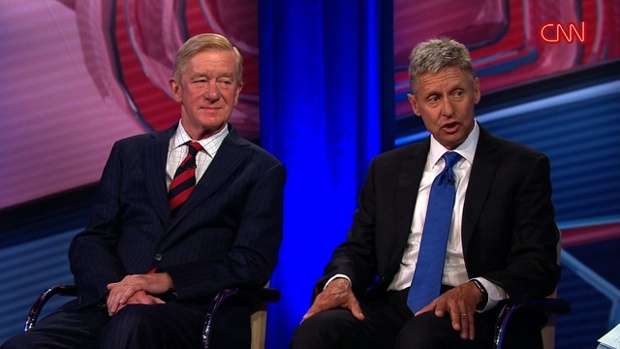
Some friends have asked what I think of Gary Johnson, the Libertarian presidential nominee, along with his running mate, Bill Weld. (Johnson is the guy on the right in the header photo.) Basically, I think Johnson is a sane choice for conservatives who abhor Trump and are mortally-opposed to Clinton, but not a good choice for progressives who are disillusioned with Clinton. I might write a separate post about possible election outcomes involving Johnson, but this post will focus on his background and position on the issues.
Legit experience
Johnson and Weld are two former Republican governors of typically-Democratic states (New Mexico and Massachusetts, respectively). Johnson is an entrepreneur who funded his entire campaign in 2012. He made his money by starting a handyman service in college, which he grew into one of New Mexico’s largest construction companies with over 1,000 employees. I listened to an interview with him from 2012 in which he said he thinks he’d hired and fired more people than any of the candidates combined (including Mitt Romney). He also said one of the things he hates most is firing people. Contrast that with Trump’s famous catchphrase, uttered gleefully: “You’re fired.” (Credit to Uncle Joe Biden on that point.)
Johnson had never even run for political office before he ran for governor of New Mexico. He won, and was re-elected to a second term. One of the things Johnson touts about his term as governor is that he vetoed more bills than all other governors combined (around 750, if memory serves). The reason I heard him state most often: He refused to grow government.
Not just a small-government conservative
Johnson sounds like a typical small-government conservative, and he basically is. He was elected governor of New Mexico as a Republican. But two characteristics make him a libertarian.
One: Socially, he’s relatively liberal or as Johnson puts it, he’s “socially agnostic.” Do what you want to do, so long as it’s not hurting anyone else and you’re not trying to enforce it on anyone else. For example, he quite openly talks about the need to legalize marijuana, and generally the need to treat drug usage as a public health issue, not a criminal issue. He’s majorly against the farcical War on Drugs, and I love him for that. He’s also in favor of marriage equality.
Two: His ideological views have been tempered by his experience as a business owner and governor. He’s not a hardcore ideologue. For example, I’ve heard him say that he really does believe that no matter what you do, there will always be some people who can’t get along without help from the government. He believes government can be helpful in creating equal opportunity. Gary isn’t touching income inequality with a ten foot pole though. He mischaracterizes the position of those who advocate for income equality as “wanting to take from one and give to another.”
Johnson presents himself in an “aw shucks” way, and tends to begin answers like, “Look, I just believe that…” When Johnson describes his views, I feel like I agree with 90% of what he says. In fact, Johnson points to results from the website “I Side With…” in which users do a blind survey of their views, and then find out which candidate they side with on most of the issues. By a wide margin in 2012, most Americans sided with Gary Johnson. The problem is they just don’t know who he is. More on that later.
‘Uber Everything’
The part where I can’t get down with Gary Johnson – and this is just me personally – is his faith in the free market. I don’t begrudge people for making money and getting rich. I’d like to do that myself someday. And my views of government have been colored by my experience working for a Holocaust museum and researching Eastern Europe during the Soviet Union’s heyday, so I’m no statist. Institutions are generally not our friends, and when government in particular has too much control and influence in everyday life, that tends to be problematic.
But my perspective has also been influenced by my interest in civil rights and the history of black people in America. I see “the market” as I see science, technology, and religion. These are all tools that can be wielded for wonderful purposes and also negative purposes.
Unfortunately, people seem to be real jerks, and lots of people will lie, cheat, steal, and exploit if given the chance. Not everyone is like that and I don’t know what makes the difference, but throughout history, people have been exploited horribly in market economies. Government – another amoral, imperfect tool – is a force that can be leveraged to prevent this exploitation. Of course it’s never that simple, but common folk don’t have many options to protect themselves in an economy that has been pretty unforgiving, especially lately.
One of Johnson’s catch phrases is “Uber Everything.” In other words, he says, let’s bring the entrepreneurialism and principles of the “sharing economy” to every industry, public and private. But the sharing economy has a seedy underbelly. Companies like Uber push all the risk onto their contractors and users. If something goes wrong with your Uber ride, Uber doesn’t care. They take their 30% and leave you to fight it out with the driver in a totally-unsatisfactory rating system. Further, Uber isn’t really on the hook for vetting its drivers and making sure you don’t get raped or killed. That was covered in some paragraph of the Terms of Service you didn’t read. And if you’re disabled and need a certain type of vehicle? Uber isn’t obligated. You’re just going to have to wait for the market to sort that one out.
The free market is great for folks like Gary Johnson, who have “made it.” Not so great for folks who are down and out and can’t get back up. I’m sure an economist out there can shred my argument, so go for it. Enlighten me. But also, take a look at history in addition to economic theory.
ISIS, terrorism, and national defense
Johnson’s position on ISIS and terrorism, while sane and reasonable, will come across as unsatisfactory to many people. Basically he believes, like I and many other people do, that our military activities in the Middle East over the last 10+ years have clearly made us less safe rather than safer, so whatever we’re doing, we need to stop.
He advocates withdrawing our troops from Afghanistan and Iraq ASAP. People say, “But won’t that be disastrous if we do that NOW?” He says, “Won’t it be disastrous in another ten or twenty years as well?” His point is, we’re going to have to take the consequences at some point, so it’s better to do it now and avoid sacrificing the huge amounts of American blood and treasure we’d surely lose over several more years. Or do we plan to stay there forever?
He calmly and frankly challenges the notion that foreign attackers actually pose that big of a threat to us. He instead draws attention to domestic terrorists, who have perpetrated almost every act of terrorism in the US since 9/11. It’s true that we greatly overestimate the threat terrorism poses to us, which causes us to react insanely and demand apocalyptic bombing campaigns, which creates more terrorists, which makes us fear terrorism more, which causes us to react insanely and demand more bombing, which causes more terrorists…
When people ask how we can prevent lone wolf attacks, Johnson basically says we can’t. He’s used the attack in Nice, France to say, “Look, if someone wants to drive a truck into a crowd of people, there are 10,000 opportunities to do that every day in America. We’re just going to have to live with that possibility and know that it’s going to happen from time to time.” That’s actually a true and realistic statement, but people don’t want to hear it. They want to hear idiots like Trump talk about how they’re going to protect everyone from everything, typically by bombing the bejesus out of everyone in the Middle East, which has actually proven to be a recipe for making Americans less safe.
That said - and I certainly don't know what I'm talking about - I’m not sure he’s totally in reality on what it takes to defend against these attacks. For example, when 84 people were killed in Nice, France, a few weeks ago, his response in an interview was basically, “That’s terrible, but I wouldn’t presume to tell France what they should do in this case – it’s their country and their security.” That’s nice, and I understand the sentiment, but it seems a little naïve of the huge amount of work governments do – or should do – in regard to intelligence-sharing and mutual preparedness. We are THE global superpower, and I’m not sure it’s a realistic option to retract so quickly and take a passive approach to national defense.
Black Lives Matter
Although he says all the right things on ending discrimination and police brutality, it’s not enough just to hold an ideological position. If anything is going to change with regard to criminal justice reform and human rights, history has demonstrated we’ll have to fight for it with superhuman tenacity and personal sacrifice. “Agreeing in principle” ain’t gonna cut it – we need a champion. Just as further evidence, this issue isn’t even one of the 13 issues highlighted on Johnson’s campaign website.
Simplifying the tax code
Johnson is a proponent for greatly simplifying the tax code, which seems necessary. He suggests abolishing the income tax and instituting a consumption tax. I don’t know much about it and never was much for cipherin’ numbers, but more information can be found at fairtax.org. My concerns about the free market apply generally here. I’m not sure what would be the ramifications of radically reforming the tax code, but I fear it would leave vulnerable folks even more vulnerable.
When Johnson proposes abolishing the IRS and Department of Education, I just don’t know what to make of that. That sounds pretty radical to me. I think I understand the impulse, but are we really prepared for the unintended consequences of those major shakeups?
Abortion
Just a quick little paragraph about abortion, which will probably be the undoing of this blog post: Johnson is pro-choice. That’s a binary nomenclature that I utterly despise, so let’s look at it a little deeper. Johnson has opposed late-term abortions in his political career, but his pro-choice position stems from his libertarian views. It’s worth listening to him talk about the issue of abortion. I wish more conservative folks held his position, because I think it’s more consistent with conservatism and compassionate than the stock Republican position. The idea is basically that it’s a complicated issue, and like most complicated issues, it would be better served by getting government out of the way. Nevertheless, I worry that most Trump supporters are going to pass on Johnson-Weld based on this singular issue. I highly encourage you to take a quick look at his position on abortion, as stated on his campaign website.
Gun control
On gun control, Johnson is where you would expect a libertarian to be. Basically, no. He’s not doing anything to limit the purchase of AR-15s or anything like that. This is one of the many reasons why Johnson ought to be considered by conservative folks who abhor Trump, but not progressive folks who abhor Clinton.
Climate change
Not mentioned on the "issues" section of Gov. Johnson's website, which says something. When I've heard him talk about it, he's said climate change is "probably real" and "probably man-made." Like a libertarian might say, I don't think he believes in large-scale government intervention to deal with climate change. I don't think this is a realistic approach, as we need as dramatic an intervention as possible, as soon as possible.
Immigration
Johnson, having been the governor of a border state, thinks Trump's plan to build a wall is not only misguided, but insane. He seems to see immigrants as real people who want to improve the lives of their families. Weird. The problem is with the United States's broken immigration system, and his solution hinges on making it easier to get guest worker visas. Not sure how that jives (or doesn't) with national security concerns.
Two heads for the price of one
The Johnson-Weld campaign is also unconventional in that they are proposing, as far as I can tell, to essentially run the country together. Their administration will have one staff instead of separate presidential and vice-presidential staffs. “Two heads for the price of one,” as Johnson puts it. Indeed, it seems like Weld has more political cache than Johnson and a more presidential presence. I’m not sure why he’s not at the top of the ticket.
Johnson as a candidate
If there’s ever been a year for a third-party candidate, this is the year. On the issues alone, Johnson should be in the running. His positions are sane. Even if folks disagree with him on this or that, you’re still likely to be within reasonable range of him.
As a person, Johnson appears glassy-eyed and kind of out of it. His responses to questions are often oddly short and demure. Most politicians just keep talking when they don’t know what to say. Johnson doesn’t do that. Overall, he doesn’t seem to have the charisma that we’ve come to expect in a candidate. I’m personally okay with that – I’d rather have someone who knows how to govern.
Is this campaign viable?
In this political season, anything is possible. With the power of viral media and the unpopularity of both mainstream candidates, I do think a third-party candidate could mount a serious challenge. But that would require some serious charisma and creativity, and it’s tough to imagine people of Johnson and Weld’s disposition overcoming the odds. I mean I watched them on a CNN town hall last night and they both just sat there like bumps on a log. I wanted to scream at the screen, “JC GARY, YOU’VE GOT TO GET MOVING!” I don’t think he could hear me.
The Johnson-Weld campaign is all about one thing right now: Getting on that debate stage. He has to poll at 15% (according to what poll, I’m not sure) in order to be included. Last I heard, he was at 13%. Johnson says most people are libertarians – they just don’t know it. If they hear him talk, they’ll probably agree with him on most of the issues. Whether or not they’ll believe in him as a leader is another issue.